

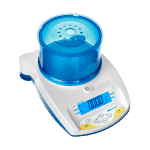
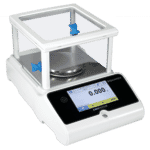
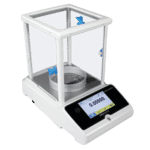
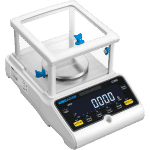
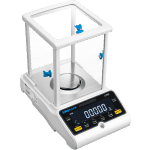
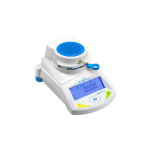
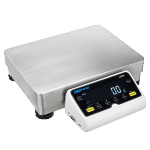

Your lab needs accurate and precise laboratory balances, but you’re not sure which one is the right fit. This blog dives into the four most common types of lab balances you'll see in any scientific laboratory. We'll provide a semi-micro balance overview, discuss analytical vs precision balances and explain the ways that moisture balances are useful.
Models |
Readability |
Capacity |
Semi-Micro Balances |
0.00001g / 0.01mg | 62g - 120g |
Analytical Balances |
0.0001g / 0.1mg |
120g - 510g |
Precision Balances |
0.001g / 1mg - 0.1g | 220g - 34kg |
Moisture Balances |
0.001g / 0.01% - 0.01g / 0.05% | 50g - 200g |
Semi-Micro Laboratory Balances
Adam Equipment offers dual-range Semi-Micro Analytical Balances, which we'll explain in more detail later. Our and models provide the highest precision in our product range, delivering results with readabilities up to five decimal places (0.00001g or 0.01mg). With capacities of 62g to 82g, they're meant to weigh tiny samples with the utmost accuracy.
Semi-micro balances offer built-in draught shields to protect against air currents, as well as a draught ring around the weighing pan as an extra precaution.
What Laboratory Tasks Require a Semi-Micro Balance?

Laboratories employ semi-micro balances for tasks such as:
- • Pharmaceutical research and development
- • Quantitative chemical analysis
- • Ensuring compliance with regulatory standards
In these areas, the tiniest decimals make a big difference.
Analytical Balances
Adam analytical balances are the next step in terms of precision, offering 0.1mg, or “four-place” readabilities and capacities between 120g and 310g. Our , and balances feature built-in draught shields but aren’t sensitive enough to require a draught ring around the pan.
What Laboratory Tasks Can Analytical Balances Perform?
Analytical balances are the perfect equipment for:
- • Sample preparation
- • Formulation
- • Quality control
You can often find analytical balances in higher education, like universities, for their laboratories and classrooms science experiments.
Dual Range Balances
Adam’s Equinox and Solis offer Semi-Micro Analytical Balance models – both in one machine, rather than separate. This is called dual range, and it increases the versatility of the balance significantly. For example, the Equinox 125i provides five-place results if the sample is below 62g in weight. Above 62g and until it hits the EAB 125i’s maximum capacity of 120g, you would get four-place readings.
Without this capability, you would have a balance that can only weigh up to 62g–about the size of the average plum. Dual range doubles your capacity in exchange for a decimal point, which is an easy trade as your samples get heavier.
Dual range also allows you to have your sample in a tared container and still get semi-micro results. If the container itself weighs less than 62g and you tare it out, you retain a full 62g’s worth of 5-decimal weight readings. As in, if you have a container worth 30g and you tare it out, instead of only having 32g worth of capacity to work with before you only get four place results, dual-range lets you maintain 62g worth of capacity.

Click the infographic above to download a reference copy
Laboratory Precision Balances
Precision balances are an excellent option when laboratories need precise and accurate results with heavier samples. Adam offers precision balances with capacities ranging from 360g with readabilities of 0.001g (1 milligram) all the way to 34kg with readabilities of 0.1g.
Precision balances with lower capacities and finer readabilities such as Adam’s typically feature a built-in draft shield like an analytical balance. As capacities and readabilities rise, the need for a draught shield has less impact on weight readings. So, balances like our , the draught shields are optional–as in, you can choose whether you use them or not, since they aren’t attached. For precision balances like our , or even our new , draught shields aren’t necessary.
What Laboratory Tasks Can Precision Balances Perform?

Because of their higher capacities, precision balances are used in more ways than analytical and semi-micro balances. They’re ideal for laboratory tasks including:
- • Underbalance or top-pan density determination
- • Formulation
- • Purity analysis
- • Quality control
- • Packaging and filling
- • Materials and conformance testing
They’re also common in the realm of education, especially secondary schools for simple experiments and dissections.
Moisture Balances
You would use moisture balances, also known as moisture analysers, to identify the level of moisture in a sample. Adam’s is an excellent example. You would spread the sample on the pan, close the lid and set the level of heat and timing on the balance. The analyzer will continually weigh the sample, then heat it until it’s dry. It will then weigh the sample again, using that result to calculate what percentage of the sample is (or was) moisture. This is the “loss on drying” method.

Moisture analysers are a more efficient alternative to the same technique using a regular balance and a laboratory oven. Since moisture analysers are much smaller than an oven, the heating and drying process is much quicker. And, since the balance is built in, you don’t have to manually weigh, heat, weigh again AND calculate the results yourself. The difference in efficiency and the reduction in the risk of human error is immense.
What Laboratory Tasks Can Moisture Analyzers Perform?
Moisture analysers are particularly adept at quality control in many industries, from food to pharmaceuticals to plastics. If a product doesn’t contain the right level of moisture, it can harm its structural integrity as well as its longevity.
Laboratory Balance Accessories
Anti-Vibration Table
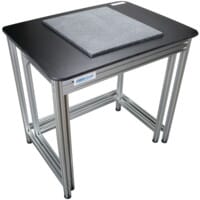
You might not realize how many vibrations occur around us at any given time. Closing a door? A vibration. Footsteps? Vibrations. Air conditioning, construction, a plane flying low in the sky or a heavy lorry passing by can all cause vibrations that make your results jump and drift. Adam’s prevent this with a heavy granite block thick enough to keep still and stabilise the balance. They can also be used with microscopes to provide a solid surface that doesn't move as much. Multifunctionality!

Ioniser
You can cause static electricity by dragging or rubbing the materials you're weighing across the pan. For example, if you’re weighing pieces of fabric or metal and they’re getting shifted along the pan as you place and pick them up.
The has two conductive needles that produce ions at a positive and negative charge when powered at a high voltage. So, when you activate it close to a balance that has lingering static electricity, it has a neutralising effect.
Printers
Keeping accurate and thorough records is crucial but writing them manually can lead to unintentional errors. For example, not being able to read a coworker’s handwriting, forgetting to record until the screen is already zeroed, or writing the wrong number. These are seemingly harmless issues that can add up into problems if they become common.
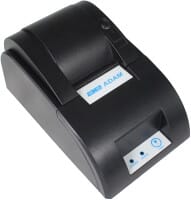
You can connect Adam's directly to the balance. It provides Good-Laboratory Practice compliant printouts at the press of a button. Good Laboratory Practice, or GLP, is a series of standards for laboratories to follow. They help keep data as traceable and reproduceable as possible to ensure that experiments are trustworthy and valid.
The receipts from Adam’s ATP-2 Printer are hard copies of real-time results and you can include other customisable data like date, time, user, piece count and more. We also recommend that you keep track of how (externally or internally) and when you calibrate your balance.
FAQ
Here are some commonly asked questions about lab balances:
What is the Difference Between Analytical and Precision Balances?
The most obvious difference between analytical and precision balances are their capacities and readabilities, which are outlined on the chart above. However, other differences include:
- • Draft shields - analytical balances offer draft shields as standard, whereas some precision balances will have one and some won't! Those that don't offer a draft shield are typically called top-pan precision balances. An example of these are our Polaris PBB models.
- • Pan sizes - precision balances typically offer larger weighing pans than analytical balances. This is because they have higher capacities, so they can hold larger samples.
What is Dual-Range Weighing and Why is it Useful?
Dual-range weighing is an excellent feature on some semi-micro and analytical balance models, like the 125i model in Adam's new Polaris range. It allows you to weigh with semi-micro readabilities until you surpass a specific amount of weight on the pan, then it automatically switches to analytical balance readabilities. This is helpful because the balance acts as a two-in-one, increasing its overall versatility in your lab.
How Do Air Currents Affect Analytical Balances?
Air currents have a negative impact on any analytical balance. Depending on the sample, the likeliest issue is that the air currents blow against the sample, which actually adds a minute amount of weight because the sample is being pressed against the pan more heavily. This is why almost all analytical balances come pre-fitted with a draft shield. This draft shield helps protect your samples from coming into contact with air currents from your environment. Ensure that you completely close the draft shield and wait for the stabilisation icon before recording your results.
Labs need accurate and precise weighing, which is why Adam offers accurate and precise laboratory balances. Let us know if you need help deciding!